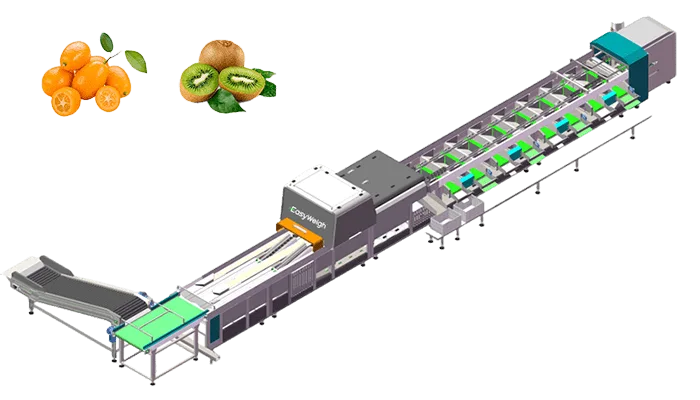
Modern production lines face severe challenges when handling irregular natural products with subtle surface flaws. Traditional color sensors rely on rigid pixel thresholds that struggle with complex color gradients, while hybrid systems pair optical intelligence with Weight Sorting parameters for maximum yield.
Artificial intelligence changes this dynamic by introducing deep learning models that interpret visual data like human experts. Understanding this technical mechanism reveals why modern plants upgrade their grading equipment with cognitive software.
Multi-Spectral Image Acquisition and Preprocessing
High-speed cameras capture continuous visual data streams as products pass through the inspection zone. Advanced illumination arrays combine visible light with infrared wavelengths to highlight hidden surface anomalies instantly.
Raw pixel matrices flow directly into high-performance graphics processing units without measurable transmission lag. Preprocessing filters eliminate optical noise caused by ambient dust or fluctuating belt speeds. Clean data preparation is essential before neural networks begin processing pixel arrangements.
Specialized line-scan sensors record high-resolution images from multiple angles to eliminate blind spots. This multi-angle capture provides convolutional networks with complete three-dimensional surface profiles.
Precise timing synchronization between strobe lights and sensor shutters prevents motion blur during peak production runs. Comprehensive visual datasets form the vital foundation for accurate artificial intelligence classification.
Convolutional Neural Networks and Feature Extraction
Convolutional neural networks form the computational backbone of modern vision systems. These networks scan multi-dimensional pixel arrays to extract complex features like texture, contour, and translucency.
Training algorithms utilize thousands of labeled images containing specific defects or foreign materials. This extensive training teaches the model to isolate true anomalies from harmless surface blemishes. An advanced optical sorting machine relies on these deep neural structures to execute complex classifications instantly.
Feature extraction layers identify geometric patterns that human inspectors often miss during manual reviews. Deep learning models evaluate spatial relationships between pixels to recognize subtle bruising or internal rot.
Unlike rigid rule-based programming, neural networks adapt automatically to natural variations in agricultural harvests. This cognitive flexibility ensures high-value products are never mistakenly rejected.
Real-Time Deep Learning Inference at the Edge
Executing complex neural computations at high line speeds requires extreme hardware efficiency. Edge-computing accelerators process high-resolution frames within microseconds of image capture. Software pipelines prioritize critical structural defects over minor cosmetic variations to maintain line throughput.
Parallel processing ensures that high-speed streams do not overwhelm internal computing resources. Easyweigh designs specialized processing modules that execute heavy machine vision algorithms without operational latency.
Inference optimization techniques compress large neural networks without sacrificing classification accuracy. Quantization methods reduce model memory footprints while maintaining microsecond response times.
Low-latency data pipelines guarantee zero data drops even during maximum operational capacity windows. Reliable edge inference bridges the gap between massive computational models and blistering physical line speeds.
Handling Complex Visual Edge Cases with Machine Learning
Real-world production environments frequently present overlapping objects and chaotic product orientations. Standard machine vision often misclassifies grouped items as single deformed units.
Machine learning models utilize spatial mapping to predict boundaries and separate overlapping shapes accurately. Supervised learning loops allow operators to retrain models dynamically when new product variations appear. Such adaptability minimizes false rejections and protects valuable raw materials from unnecessary waste.
Clustered items often create ambiguous shadow patterns that confuse traditional photoelectric sensors. Vision models analyze lighting gradients and contour shadows to distinguish individual units reliably.
Object detection bounding boxes outline distinct items even when they touch or overlap on the conveyor belt. Advanced spatial algorithms solve complex separation challenges that previously required constant manual supervision.
Integrating AI Vision with Multi-Parameter Inspection
Vision intelligence becomes even more powerful when merged with physical measurement technologies. Combining surface image analysis with integrated Weight Sorting creates a multi-dimensional inspection matrix.
Software algorithms cross-reference visual surface defects against precise gravitational data simultaneously. This dual-layer approach ensures that substandard units are identified regardless of orientation or weight variations. Easyweigh integrates these comprehensive inspection layers into robust industrial processing frameworks.
Multi-parameter evaluation allows plants to enforce strict quality grades based on both appearance and mass. A visual blemish combined with an unexpected weight reading triggers immediate classification flags.
Unified software dashboards display both optical and physical metrics on a single interface. This holistic inspection methodology maximizes product yield while maintaining absolute brand compliance standards.
Adaptive Learning and Future Vision Optimization
Continuous feedback loops enable inspection systems to refine their internal classification weights automatically. Operators tag ambiguous items on intuitive touchscreen panels to supply new training samples to the model.
Fleet-wide telemetry updates deliver optimized recognition matrices derived from global operational data. These self-improving loops guarantee that an optical sorting machine maintains peak performance over multi-year lifecycles.
Active learning protocols allow neural networks to request human clarification on borderline product samples. Every operator correction strengthens the underlying dataset and improves future decision accuracy.
Autonomous model updates reduce the need for manual recoding by specialized software engineers. Intelligent systems evolve alongside changing agricultural seasons and evolving product quality standards.
Enhancing Quality Control Through Intelligent Vision
Balancing microscopic surface evaluation with precise Weight Sorting delivers unprecedented quality assurance standards. Food safety regulations demand rigorous tracking, which intelligent vision logs satisfy effortlessly.
Modern facilities utilizing an optical sorting machine eliminate human inspection fatigue entirely. Easyweigh provides advanced machine vision engineering designed to meet tightening global manufacturing tolerances.
Cognitive vision systems reduce operational errors by removing subjective human judgment from grading routines. High-speed neural processing ensures consistent classification quality across twenty-four-hour operating shifts.
Automated quality auditing logs provide complete transparency for downstream regulatory compliance inspections. Smart factories rely on these AI-driven inspection architectures to maintain market leadership.