Dental implant restoration requires more than replacing missing teeth. A successful implant must function naturally within the patient’s oral system, including proper alignment, bite force distribution, and harmony between the restoration and surrounding structures.
While implant placement focuses on achieving stable integration between the implant and bone, the final restoration depends heavily on accurate treatment planning. Understanding the relationship between the upper and lower jaws is essential for creating restorations that fit comfortably and perform effectively.
A precise jaw relation record provides important information about the spatial relationship between the maxilla and mandible. When this information is integrated into digital implant workflows, clinicians can improve restoration design, reduce occlusal complications, and achieve more predictable results.
The Importance of Jaw Relation in Implant Restoration
- Beyond Implant Position: Evaluating Functional Relationships
Dental implants are designed to restore both aesthetics and oral function. However, the position of an implant crown or bridge cannot be considered independently from the patient’s overall bite relationship.
The concept of jaw relation refers to the positional relationship between the upper and lower jaws, which influences occlusion, chewing efficiency, and the forces applied to implant restorations.
If this relationship is not accurately evaluated, implant restorations may experience uneven loading. Excessive pressure on certain areas can affect patient comfort and may contribute to long-term mechanical issues.
By capturing accurate jaw information before restoration, clinicians can better understand how the implant will interact with the patient’s natural dentition.
- Improving Accuracy Through Digital Jaw Relation Records
Traditional methods of recording bite relationships have been widely used in implant dentistry. However, they may depend heavily on manual procedures and clinician experience.
A digital jaw relation record provides a more comprehensive approach by capturing precise spatial information that can be integrated with other digital patient data.
When combined with intraoral scans, facial scans, and implant planning data, digital jaw records help create a more complete representation of the patient’s oral condition. This allows clinicians and dental laboratories to design restorations with greater consideration of functional requirements.
How Jaw Relation Records Support Better Implant Fit?
- Creating More Accurate Prosthetic Designs
The final implant restoration must match the patient’s bite, facial structure, and functional movement. A restoration that looks correct but does not fit the patient’s natural jaw function may cause discomfort or require additional adjustments.
A reliable jaw relation record helps dental professionals evaluate the correct vertical dimension, occlusal position, and relationship between opposing teeth. This information supports the design of implant crowns, bridges, and full-arch restorations that are more consistent with the patient’s existing oral mechanics.
- Reducing Occlusal Adjustment After Restoration
One common challenge in implant dentistry is the need for multiple adjustments after placing the final restoration. Although minor adjustments are sometimes necessary, inaccurate bite information can increase chair time and affect treatment efficiency.
By incorporating digital jaw relation data during the planning stage, clinicians can better predict how restorations will contact opposing teeth. This proactive approach allows dental teams to optimize restoration design before manufacturing, helping improve workflow efficiency and patient satisfaction.
Digital Workflow Solutions for Advanced Implant Planning
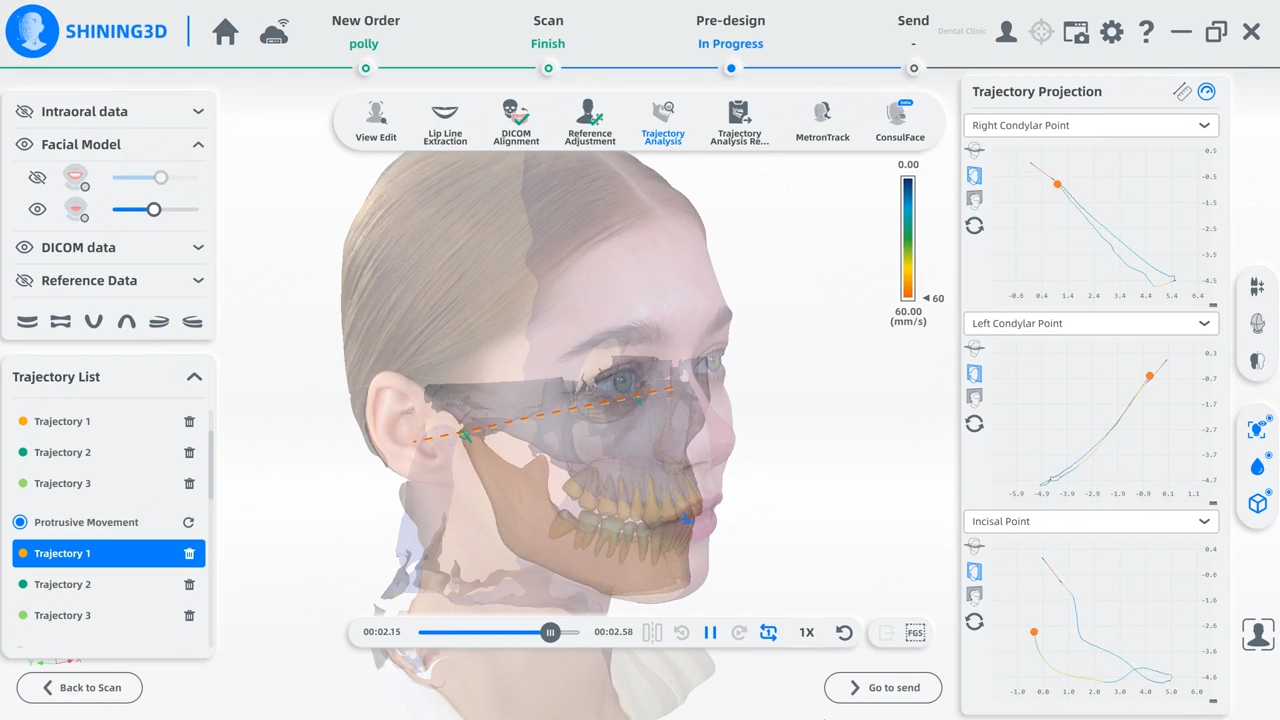
SHINING 3D DENTAL develops digital dentistry solutions that support accurate diagnosis, treatment planning, and communication between dental professionals. Its e-Motion Workstation is designed to integrate jaw motion tracking, intraoral scanning, and facial data acquisition into a unified digital workflow.
The system supports the acquisition of a digital jaw relation record and provides information about functional jaw behavior. By combining static bite relationships with dynamic movement analysis, clinicians can gain deeper insights into how implant restorations should interact with the patient’s oral system. This integrated approach helps bridge the gap between implant planning and functional restoration design.
The Role of Dynamic Information in Implant Dentistry
- Understanding Real-Life Jaw Function
The human jaw is constantly moving during daily activities such as speaking, chewing, and swallowing. Therefore, implant treatment planning should consider not only where teeth contact but also how the jaw moves during function.
Digital analysis of jaw relation can provide additional information about mandibular positioning and movement patterns.
When clinicians understand both static and dynamic relationships, they can make more informed decisions about implant restoration design and occlusal management.
- Enhancing Collaboration Between Clinics and Laboratories
Successful implant treatment often requires close cooperation between dentists and dental technicians. Accurate digital information improves communication and reduces uncertainty during the restoration process.
A detailed jaw relation record allows dental laboratories to better understand the patient’s functional requirements when designing implant-supported restorations. With digital platforms that combine multiple data sources, teams can work from a shared patient model and improve consistency throughout the treatment workflow.
When Should Implant Dentists Consider Digital Jaw Relation Analysis?
Not every implant case requires advanced digital jaw analysis. However, it can provide significant value for complex situations, including:
- Full-mouth implant rehabilitation
- Multiple implant restorations
- Full-arch implant-supported prostheses
- Patients with complicated occlusal conditions
- Cases requiring precise aesthetic and functional balance
- Treatments involving interdisciplinary dental teams
In these cases, understanding the patient’s complete jaw relationship can support more predictable outcomes.
Improving Implant Outcomes Through Comprehensive Digital Dentistry
The success of dental implant treatment depends on many factors, including implant placement accuracy, restoration design, and functional integration. A detailed understanding of jaw relationships provides an important foundation for achieving a comfortable and stable result.
By using a precise jaw relation record and analyzing jaw relation within a digital workflow, dental professionals can improve communication, optimize restoration design, and reduce potential complications.
With solutions such as SHINING 3D DENTAL e-Motion, implant teams can incorporate advanced digital information into modern treatment planning. As dentistry continues to evolve, combining accurate jaw analysis with digital technologies will play an increasingly important role in delivering predictable and patient-centered implant solutions.