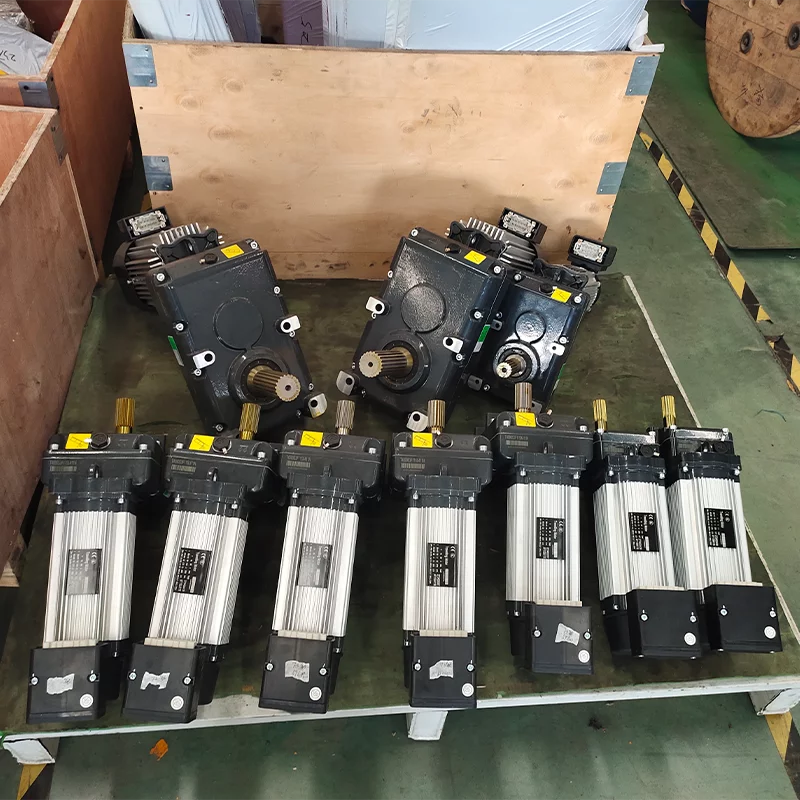
Accurate load placement is an important consideration in crane and hoist operations. Loads positioned beside production lines, storage locations, or within restricted working areas require controlled movement to support efficient handling and consistent workflows. For this reason, manufacturers increasingly examine how drive technology, braking performance, and control systems influence positioning accuracy.
The choice between electronic and mechanical positioning is not simply a matter of selecting one technology over another. The most suitable approach depends on the crane design, load characteristics, operating cycle, required accuracy, and control strategy. A properly selected gearmotor can provide an important foundation for controlled movement and repeatable load handling.
Why Positioning Accuracy Matters in Crane Operations
Crane load positioning involves more than moving a load from one point to another. The crane must accelerate smoothly, travel at an appropriate speed, decelerate at the correct moment, and stop with sufficient control. If the system overshoots the target or requires frequent manual correction, operators may spend additional time adjusting the load.
Poor positioning can also increase swing, mechanical stress, and unnecessary movement. In applications where materials must be placed accurately within production or storage areas, repeatability becomes particularly important.
A precise positioning crane therefore requires coordination between the motor, gearbox, brake, control system, and mechanical structure. Each component contributes to how accurately the crane responds to operator commands.
Electronic vs Mechanical Positioning in Crane Systems
When considering electronic vs mechanical positioning, it is useful to understand that the two approaches address different aspects of movement control.
Mechanical positioning relies heavily on physical components such as brakes, gears, couplings, limit mechanisms, and mechanical stops. These components determine how movement is transmitted and controlled. A well designed mechanical system can provide dependable stopping performance, but mechanical wear, backlash, and load variation may affect positioning over time.
Electronic positioning uses control technology to regulate motor speed, acceleration, deceleration, and stopping behavior. Variable frequency drives, sensors, encoders, and programmable controls can allow the crane to respond more precisely to movement commands.
In practice, modern crane systems often combine electronic control with mechanical braking rather than treating the two approaches as mutually exclusive. Electronic control manages movement while mechanical components provide the physical transmission and stopping functions required by the application.
How a Gearmotor Influences Positioning Performance
The gearmotor is a key part of the crane drive system because it converts motor speed and torque into the mechanical movement required by the equipment. Its characteristics directly influence acceleration, travel speed, braking behavior, and overall responsiveness.
A gearmotor with an appropriate transmission ratio can provide the torque required to move a load while keeping the operating speed within a controllable range. If the drive is incorrectly selected, the crane may accelerate too aggressively, respond slowly, or experience difficulty stopping smoothly.
For positioning applications, the relationship between motor speed, gearbox ratio, brake response, and control settings should therefore be considered as a complete system. Selecting a motor based only on rated power may not provide the desired positioning performance.
Improving Crane Load Positioning Through Speed Control
Speed control is particularly important when accurate placement is required. High travel speed can improve productivity over long distances, but the crane needs controlled deceleration as it approaches the target position.
Variable frequency control can allow a drive system to operate at different speeds during a movement cycle. The crane can travel more quickly when moving across an open area and slow down before reaching the target. This reduces the amount of manual correction required and can help produce more consistent positioning.
Acceleration and deceleration settings should also match the load and mechanical characteristics of the crane. Excessively rapid changes in speed can cause load swing, while overly slow movement may reduce operational efficiency. The appropriate settings depend on the application and should be evaluated during commissioning and maintenance.
The Role of Braking in Precise Positioning
Electronic speed control alone does not determine final positioning accuracy. The braking system is equally important because the crane must transition from controlled movement to a stable stop.
An electromagnetic disc brake can provide the mechanical stopping function required when the motor is not driving the load. Brake response, wear condition, and adjustment should be monitored as part of regular maintenance.
Gearmotor selection should therefore consider both motor performance and braking characteristics. A system that accelerates smoothly but has inconsistent braking may still produce inaccurate final positioning.
Building a Hoist Precise Positioning System
A hoist precise positioning system may incorporate several technologies depending on the required level of control. These can include variable frequency drives, sensors, encoders, programmable controls, mechanical brakes, and appropriately specified gearmotors.
The operating environment should also be considered. Dust, temperature, humidity, frequent starts and stops, and varying loads can influence component performance. The control strategy should reflect the actual duty cycle rather than relying solely on nominal operating conditions.
For applications requiring repeatable positioning, commissioning is particularly important. Acceleration, deceleration, travel speed, braking, and control parameters should be tested under representative load conditions. This helps identify excessive movement or delayed response before the equipment enters routine operation.
WORLDHOISTS Gearmotors for Controlled Crane Movement
WORLDHOISTS provides gearmotor solutions designed for crane travel applications where controlled movement and reliable mechanical transmission are important. Its gearmotor configurations incorporate variable frequency speed control, allowing travel performance to be adjusted according to operating requirements.
The company states that its gearmotors are designed for heavy duty applications with a 60% ED duty cycle and can reach speeds of up to 4,800 RPM. The units also incorporate overheating protection, an IP55 rated sealed housing, and electromagnetic disc brakes. These features are relevant when evaluating a drive system for demanding crane operating conditions.
WORLDHOISTS also offers planetary gearmotor configurations using direct drive technology. The transmission arrangement is intended to reduce the need for additional couplings within the drive structure while providing the torque and speed characteristics required for crane movement.
Toward More Consistent Load Placement
Positioning accuracy has become an important consideration wherever cranes must place materials consistently and efficiently. Understanding the differences between electronic vs mechanical positioning can help equipment planners select a control strategy that matches actual operational requirements.
Rather than viewing positioning as a function of a single component, it is more practical to evaluate the complete drive system. With an appropriately specified gearmotor, controlled acceleration and deceleration, dependable braking, and suitable electronic controls, crane systems can achieve smoother movement and more repeatable load placement. WORLDHOISTS gearmotor solutions provide one option for integrating these requirements into crane travel and hoist applications.