Industrial real estate premiums have completely transformed how enterprises approach inventory management across the global supply chain. Traditional warehouses often rely on forklifts, conventional racking, and manual or semi-automated handling processes. As inventory requirements grow, operators may need to reassess their storage layouts and available floor space.
When warehouse capacity becomes constrained, businesses can compare expanding existing facilities with introducing high-density AS/RS solutions. The appropriate choice depends on available building space, storage requirements, throughput targets, and investment budgets. To continuously scale operations without acquiring expensive new land, forward-thinking logistics directors are abandoning legacy methods in favor of high-density vertical solutions.
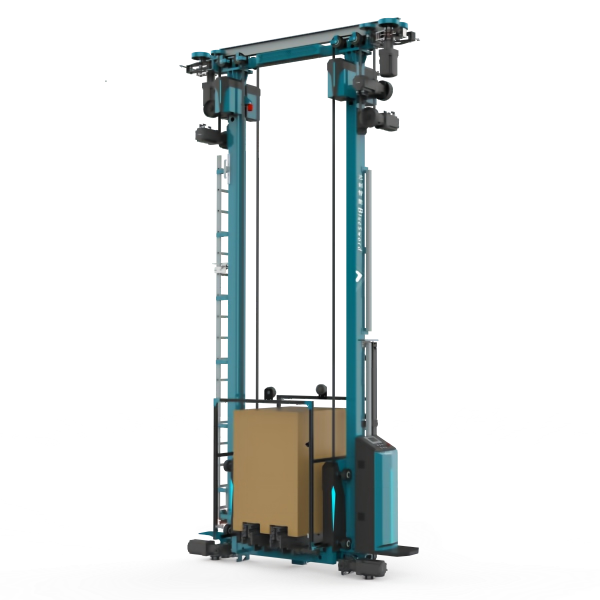
An automated storage and retrieval system (AS/RS) can replace selected manual storage and retrieval tasks with automated equipment, such as stacker cranes. Compared with traditional warehouse operations, a stacker crane-based AS/RS can make better use of vertical storage space and support more consistent pallet handling.
Overcoming Vertical Space Limitations and Payload Constraints
Conventional distribution hubs typically waste massive amounts of overhead clearance because human-operated mast lifts lose structural stability at extreme elevations. This physical limitation creates an artificial ceiling on your total inventory capacity.
To conquer this specific architectural hurdle, BlueSword engineers their robust Stacker Crane to operate seamlessly at extraordinary heights. BlueSword offers a range of stacker crane models for different storage requirements, with lifting heights of 18 m, 24 m, and 30 m, and customized high-bay configurations reaching up to 45 m.
When combined with a broader automated warehouse shuttle system, this massive increase in vertical density enables facilities to multiply their total holding volume without undergoing costly lateral building expansions.
Beyond merely reaching greater elevations, heavy industrial material handling demands immense structural rigidity and consistent payload endurance. Manual processes struggle to safely elevate dense raw materials, frequently leading to dropped pallets, damaged inventory, and hazardous workplace accidents.
In a stacker crane-based AS/RS, automated cranes handle pallet storage and retrieval within designated rack aisles, reducing the need for manual forklift operations in those storage areas. BlueSword offers stacker crane models for different load requirements, ranging from 100 kg and 300 kg miniload configurations to pallet-level models rated at 1,000 kg and 1,500 kg. For heavy-load applications, the UnitLoad-Titan supports a rated load of up to 12,000 kg.
The stacker crane uses coordinated control systems to manage horizontal travel, vertical lifting, and fork movements during pallet storage and retrieval.
Enhancing Throughput Speed and Operational Safety
During periods of high warehouse activity, manual forklift operations can become constrained by aisle access, operator availability, and traffic coordination. Automated stacker cranes provide controlled pallet storage and retrieval within designated rack aisles, supporting more consistent material flow. Upgrading your infrastructure directly targets these frustrating horizontal bottlenecks by introducing exceptionally fast, mechanized transit routines.
Automated stacker cranes can provide consistent pallet storage and retrieval performance, with operating speeds depending on the selected model and system design. BlueSword’s stacker crane models offer different operating speeds according to their configurations. For example, the UnitLoad-Summit reaches a horizontal speed of 200 m/min and a vertical speed of 80 m/min, while the UnitLoad-Libra reaches a horizontal speed of 340 m/min and a vertical speed of 60 m/min.
Automated travel, lifting, and fork movements help standardize storage and retrieval cycles, reducing reliance on manual handling in designated warehouse areas.
Maintaining this extreme velocity requires sophisticated safety protocols and robust environmental adaptability. Manual operators frequently cause structural damage when navigating tight channels at high speeds, but intelligent machinery utilizes preventative algorithms to secure the workspace.
BlueSword’s stacker cranes incorporate contact-based emergency stop mechanisms and non-contact 3D vision sensors for obstacle detection. Their auto-correction systems also help manage mast sway and pallet deviation within ±5 mm.
BlueSword also offers cold-storage stacker crane configurations designed for operating environments as low as -25°C, alongside explosion-proof and corrosion-resistant variants for specific industrial applications.
BlueSword’s stacker crane safety systems feature TÜV Rheinland-certified PLd safety, supporting the equipment’s safety requirements in automated warehouse operations.
Achieving Energy Efficiency and Intelligent System Reliability
Standard warehousing practices inherently waste massive amounts of electricity, as human-driven machinery constantly drains utility budgets without optimized, predictable motion paths. Modernizing a distribution center with an intelligent AS/RS not only optimizes physical space but also introduces highly sustainable energy consumption practices.
BlueSword integrates a proprietary S-curve control algorithm into its stacker cranes to support smooth acceleration and deceleration during operation, helping improve motion control.
BlueSword’s stacker cranes also feature regenerative energy conversion and a shared DC bus with capacitor or battery storage. These technologies support energy recovery and can deliver energy savings of over 30%.
Transforming Traditional Warehouses with Automated Shuttle Systems
Traditional warehousing and automated storage systems serve different operational requirements. For businesses handling large pallet volumes in space-constrained facilities, a stacker crane-based AS/RS can provide a more structured approach to storage and retrieval.
Embracing a highly mechanized automated warehouse shuttle system transforms chaotic distribution hubs into precise, vertically optimized, and incredibly dense fulfillment centers. By completely redefining capacity limits, accelerating payload transit, and integrating sustainable energy recovery, businesses can help improve storage density, retrieval efficiency, and overall warehouse flow.
Selecting the right storage strategy depends on a facility’s inventory profile, throughput requirements, available space, and investment priorities. For suitable applications, BlueSword’s stacker crane solutions can help businesses improve storage density and automate pallet handling as part of a broader AS/RS.