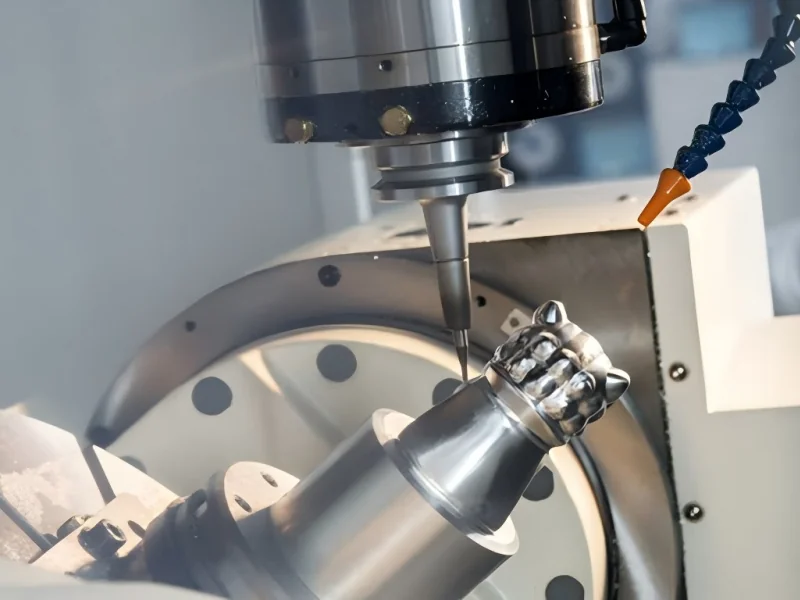
Complex parts are harder to machine when critical features sit on several faces, at compound angles, or along contoured surfaces. The challenge is not only the shape shown in CAD. Tool access, cutter length, datum strategy, workholding, and the number of setups all influence whether the geometry can be produced efficiently and inspected with confidence.
APT-Mold lists 3-axis, 4-axis, and 5-axis milling within its CNC capabilities. For engineers comparing a custom CNC precision machine service, the important issue is deciding when additional axis movement actually solves a manufacturing problem rather than adding unnecessary programming and fixturing complexity.
Why Complex Geometry Creates Access and Setup Problems
A conventional 3-axis milling machine moves along X, Y, and Z while the cutter direction normally remains fixed. That arrangement is effective for many flat faces, pockets, slots, and holes approached from a limited number of directions. Problems arise when a tool must reach around another feature or when several important surfaces face different directions.
One response is to re-clamp the workpiece in a new orientation. Every additional setup, however, requires the part to be located again. The relationship between previously machined features and later operations must then be maintained through fixturing, datum transfer, and inspection.
Tool reach creates another constraint. A deep cavity or inclined surface may force the use of a long cutter when the machine cannot approach from a better angle. Excessive overhang reduces stiffness and increases the risk of vibration, deflection, or poor surface finish.
Those effects become more important when slender features or closely related dimensions are involved. Surface orientation also affects how effectively the cutter engages the material, so better access can improve not only reach but also the practicality of the toolpath.
When Does a Custom CNC Precision Machine Service Need 5-Axis Machining?
5-axis CNC machining adds two rotary degrees of freedom to the three linear axes. Depending on the machine and toolpath, those axes may reposition the part between cuts or move in coordination with the linear axes. The practical benefit is the ability to change the relationship between the cutter and the workpiece.
That flexibility is useful for:
- compound-angle holes and mounting faces;
- curved or sculpted surfaces;
- features distributed around several sides of a component;
- cavities where a better approach angle permits a shorter, stiffer tool;
- parts whose critical features are easier to preserve within fewer setups.
This does not mean every complicated-looking component requires 5-axis CNC machining. A mostly prismatic part may still be better produced with a simpler machine and well-planned fixtures.
The decision should come from access, tolerance relationships, surface requirements, and setup count rather than visual complexity alone. That is also how APT-Mold’s mix of 3-axis, 4-axis, and 5-axis options is best interpreted: as a range of process choices rather than a hierarchy.
Fewer Setups Can Protect Feature Relationships
When several important features are machined before the workpiece leaves the fixture, fewer datum transfers are required. That can be valuable for related bores, angled holes, intersecting features, or surfaces controlled from the same reference structure.
The advantage is often misunderstood. Fewer setups do not automatically create an accurate part. Machine condition, programming, tool wear, workholding, inspection, and material behavior still matter. What changes is the number of opportunities for alignment error to enter when the workpiece is repeatedly repositioned.
Workholding remains central to the plan. The fixture must secure the part without blocking the cutter, while the spindle, holder, tool, fixture, and machine envelope need enough clearance through the programmed motion.
The machining provider therefore has to evaluate the complete machining environment, not only the nominal geometry in the CAD model.
Match Axis Strategy to Geometry, Material, and Quantity
Before choosing 5-axis CNC machining, engineers should identify which surfaces need access, which dimensions share common datums, and where tool overhang could become excessive.
Material and wall thickness also affect the strategy because a thin aluminum feature and a thick engineering-plastic component do not respond to cutting forces in the same way.
Production quantity changes the economics as well. A more sophisticated toolpath may reduce setups, but programming and fixture development still have to be justified by the number of parts and the repeatability required.
DFM review helps clarify those trade-offs. Through a custom CNC precision machine service, difficult radii, deep pockets, inaccessible faces, or unnecessarily restrictive tolerances can be identified before machining begins.
According to APT-Mold’s CNC service information, the available material range covers more than 60 engineering-grade metals and plastics and supports prototypes through low- and high-volume production.
That range makes process selection a geometry-and-production decision rather than an assumption that the machine with the most axes is always preferable.
Conclusion
Multi-axis machining handles complex geometries by giving the cutter more useful approach angles and reducing the need to reposition the workpiece repeatedly. Its strongest applications involve multi-sided, angled, or contoured features where access, tool reach, and datum relationships are difficult to manage with simpler setups.
The right choice still depends on material, tolerance structure, quantity, fixturing, and inspection. A well-planned process uses extra axis movement only where it removes a real manufacturing constraint.