Commercial dental and medical laboratories frequently encounter a formidable operational ceiling: physical workspace limitations. As case volumes rise and clinical demand shifts firmly toward digital restorations, lab managers face mounting pressure to expand production capabilities.
However, relocating to a larger facility or leasing adjacent commercial real estate involves significant capital expenditure, lengthy downtime, and logistical disruption. This reality prompts a critical question among procurement decision-makers and senior technicians: How can a growing laboratory scale up additive manufacturing output and meet tighter delivery windows without expanding its physical footprint?
Traditional manufacturing paradigms often assumed that higher output required heavier, larger machinery that demanded dedicated, expansive rooms. Fortunately, modern additive engineering challenges this assumption. By adopting streamlined workflows and space-efficient hardware, laboratories can significantly elevate their daily capacity within their existing floor plans.
Rethinking Production Through Compact Additive Technologies
Physical expansion is rarely the only solution to capacity bottlenecks. Instead of acquiring more square footage, facilities can re-evaluate how equipment is deployed across their current layout. Compact SLM systems give dental laboratories another option for organizing metal additive manufacturing within limited production areas. Rather than relying on massive legacy systems designed for industrial foundries, modern facilities benefit from purpose-built architecture engineered for high-density environments.
With experience in laser equipment development and dental metal 3D printing,
Riton has developed compact SLM systems for laboratories working within limited
production spaces.Their comprehensive “equipment + platform + service” digital ecosystem is designed to integrate smoothly into existing laboratory workflows without requiring extensive structural renovations.
When evaluating how slm metal 3D printing fits into a confined room, technical personnel must look closely at operational parameters. Modern selective laser melting systems utilize advanced fiber laser sources, precision optical scanners, and automated auxiliary features to maintain high performance while occupying minimal floor space.
Integrating a Small Metal 3D Printer for High-Density Workflows
Procurement teams investigating space-saving hardware frequently ask: What specific technical features enable a compact system to match the productivity of larger legacy machines without compromising part integrity? The answer lies in optimized chamber design, rapid gas exchange cycles, and intelligent software integration that supports continuous facility scaling.
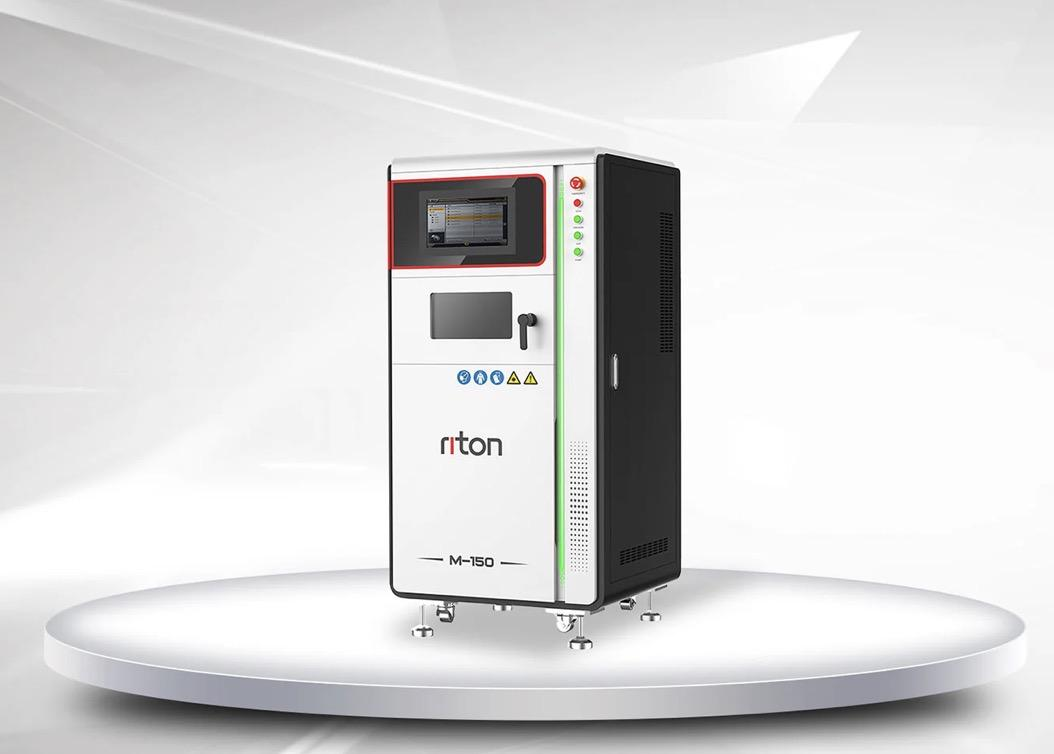
A prime example of this approach is found in modern production lines such as the M-150 Series small metal 3D printer. Engineered specifically for precision dental metal restoration production, these systems feature a compact footprint while delivering robust performance. The standard M-150 configuration features a $150 mm x 140mm melting area, including the build plate, and a single fiber laser. A dual-laser configuration is also available as a separate option, with scanning speed and production capacity depending on the selected configuration. Furthermore, functions such as automatic protective gas filling and oxygen level monitoring help streamline the setup phase and cut preparatory downtime between print jobs.
By utilizing optimized build chambers, technicians can load and prepare powder efficiently, minimizing material waste and ensuring consistent medical-grade quality control across every batch. Stable equipment operation can help laboratories plan production more consistently, although routine inspection, calibration, and preventive maintenance remain necessary. Specialized dental technical support further guarantees that operators can resolve minor tuning challenges swiftly.
Real-World Application Scenario in an Urban Laboratory
Consider a mid-sized commercial laboratory situated in a densely populated metropolitan area where commercial real estate costs are exceptionally high. The facility experienced a steady surge in demand for cobalt-chromium crowns, bridges, and removable partial dentures. Initially, management considered renting an adjacent office space to accommodate a second large printing unit, but the projected rent increase and renovation costs rendered the option economically unfeasible.
By replacing an older, bulky milling setup with a compact high-performance printing system, the laboratory optimized its existing floor plan. The new equipment required less than half the floor space of traditional setups while doubling the daily output of metal frameworks. Technicians benefited from streamlined digital file transfer, intuitive operating software, and responsive technical support backed by global service networks. Consequently, the laboratory successfully fulfilled its client orders ahead of schedule, reduced operational overhead, and achieved sustainable growth without moving to a new location.
Ensuring Long-Term Operational Success and Support
Successfully scaling production in a confined space requires more than just installing new hardware. It depends heavily on robust pre-sales and after-sales support networks. Laboratories operating under tight schedules require reliable maintenance, rapid spare parts availability, and expert guidance on alloy parameters.
Technical support and maintenance planning are also important when installing metal 3D printing equipment in a space-limited laboratory. Access to maintenance assistance and replacement parts can help reduce interruptions without requiring additional production space.
Furthermore, competitive lead times and rigorous quality standards help businesses maintain steady workflow momentum.
Physical space limitations do not necessarily prevent laboratory growth. By selecting appropriately sized equipment and planning auxiliary processes, laboratories can make better use of existing facilities while supporting more efficient metal additive manufacturing.