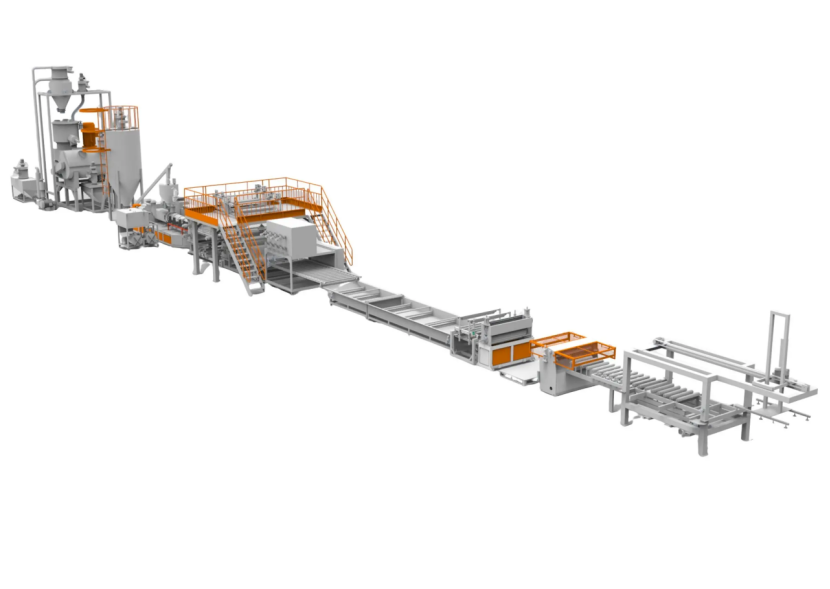
In the high-speed production of Luxury Vinyl Tile (LVT), the quality of the final plank is often determined by what is removed during the process rather than what is added. Because LVT formulations involve a high concentration of PVC resin and calcium carbonate fillers, the melting process naturally generates volatiles, including moisture, air, and residual monomers. If these gases are trapped within the polymer melt, they cause internal voids, surface bubbles, and structural weaknesses that compromise the product’s integrity.
The Role of Degassing in an LVT Flooring Production Line
Optimizing the venting and degassing phase is essential for maintaining the high-density requirements of commercial-grade flooring. This process typically occurs within the barrel of a twin-screw extruder, where a vacuum venting port is strategically positioned. As the screws shear and melt the material, the increased surface area allows trapped gases to escape into the vacuum zone. In a sophisticated LVT flooring production line, the efficiency of this degassing is a primary factor in preventing “silver streaks” or pitting on the wear layer of the final tile.
Effective degassing requires a precise balance of screw geometry and vacuum pressure. If the vacuum is too weak, the melt remains porous; if the screw speed is improperly calibrated, the material may “vent-flow,” causing the polymer to escape through the exhaust port and clog the system. For B2B manufacturers, achieving a 99.9% gas-free melt is critical for ensuring that the subsequent calendering and laminating stages produce a perfectly smooth, bubble-free surface that meets rigorous ISO and ASTM industrial standards.
Engineering Excellence from Boyu
As a global leader in high-performance extrusion technology, Boyu has engineered their LVT flooring extrusion line to handle the most demanding degassing requirements. Their machinery features specialized screw designs that optimize the decompression zone, ensuring maximum surface renewal for gas release. By utilizing high-vacuum systems and corrosion-resistant venting ports, they maintain a stable extrusion process, even when running formulations with high filler content.
The technical design of their equipment reflects a deep understanding of the 2B manufacturing landscape, where durability and uptime are paramount. Their systems are built to minimize maintenance on vacuum components while maximizing the clarity and strength of the extruded sheet. By providing a stable and efficient degassing environment, Boyu allow flooring producers to achieve superior mechanical properties and aesthetic consistency in every batch. Their commitment to technical precision makes them a preferred partner for industrial-scale flooring production worldwide.